
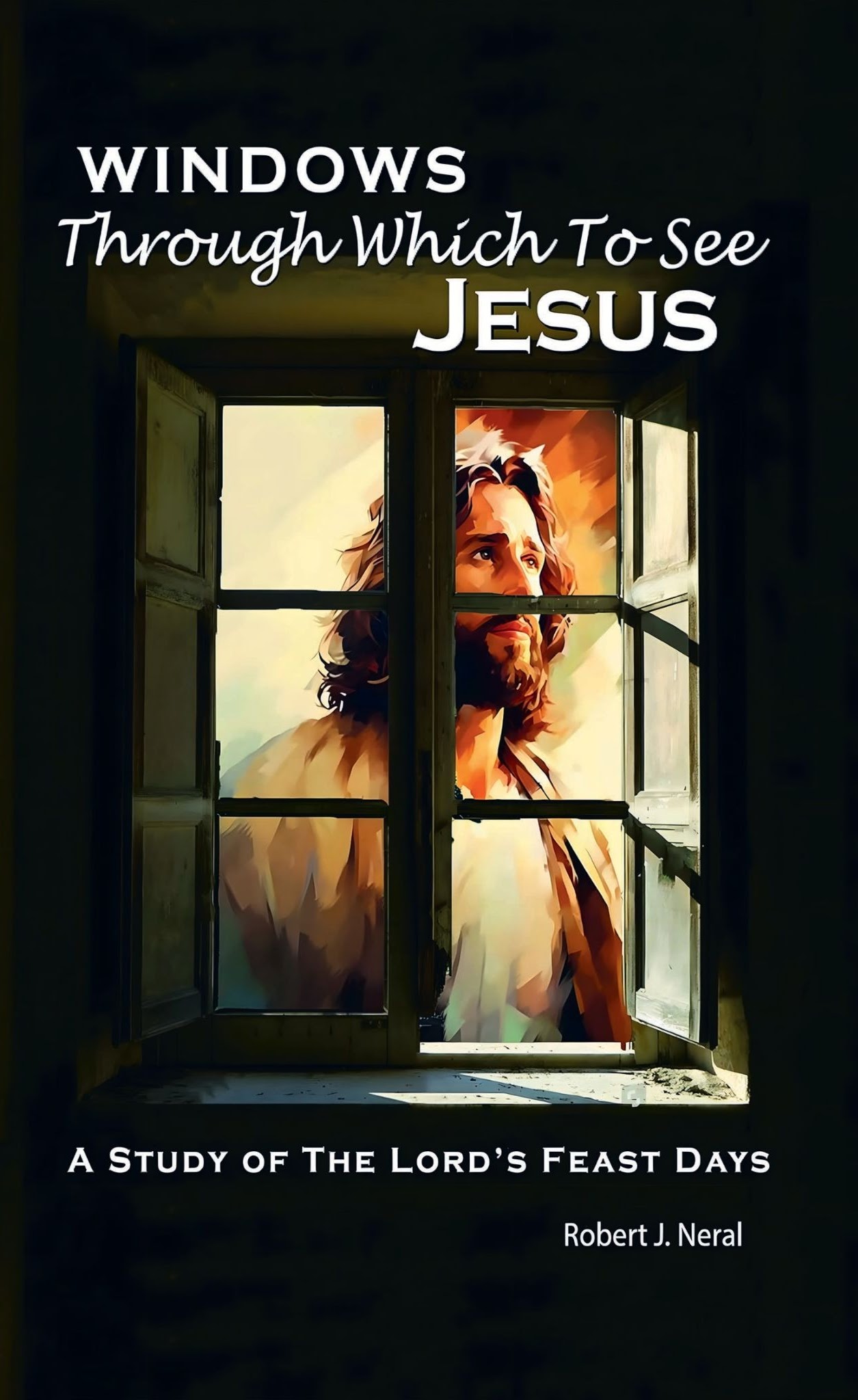
The Big Idea
Windows Through Which to See Jesus is a pastoral study of the seven biblical feast days as prophetic windows revealing God's complete redemptive plan in Jesus Christ. Pastor Robert J. Neral, drawing on most of the last 40 years of biblical study, presents a systematic case that the Old Testament feast days are not merely Jewish observances but divinely ordained appointments—literal markers in time—through which God disclosed the future of salvation history with stunning precision. The book's central thesis is both simple and provocative: if modern Christians understood that Jesus died on Passover, not Good Friday, the unity of Scripture would become unmistakable, and the path to sharing the gospel with Jewish communities would be clear.
The book argues that God, existing outside time and space, saw the complete timeline of human history and embedded prophetic detail into the feast days fifteen hundred years before Christ. Each feast functions as a "window" through which readers can see Jesus—not as a metaphor, but as literal prophetic fulfillment. The crucifixion, resurrection, and coming of the Holy Spirit are not random events; they are the exact fulfillment of the spring feasts (Passover, Unleavened Bread, First Fruits, and Pentecost). The fall feasts (Trumpets, Day of Atonement, and Tabernacles) remain unfulfilled and point to the end times with the same precision.
Pastor Robert does not write as an academic or theologian. He writes as a shepherd who has sat with his congregation for over 28 years, inviting readers into a conversation rather than delivering a lecture. His voice is warm, patient, and grounded in Scripture—always pointing back to the Word. The book's structure mirrors the feast days themselves: it moves sequentially through the seven appointed times, building a cumulative argument piece by piece, like assembling a puzzle. By the end, the reader is meant to step back and see the complete picture—a timeline stretching from creation to eternity, with Jesus at the center of every prophetic window.
The Central Argument: Jesus Died on Passover, Not Friday
The heart of this book is a detailed scriptural case that Jesus was crucified on Thursday, the 14th of Nisan—Passover—not on Friday as traditional Christian teaching has held for nearly two millennia. Pastor Robert does not make this claim lightly. He devotes the longest chapter of the book (Chapter 5) to walking the reader day by day from Palm Sunday through Resurrection Sunday, citing Gospel accounts, Jewish timekeeping, and the prophetic structure of the feast days themselves.
The argument begins with Jesus' own words:
For as Jonah was three days and three nights in the belly of the great fish, so will the Son of Man be three days and three nights in the heart of the earth.
— Chapter 5, Time of the Lord's Passover in Jesus
Pastor Robert takes this statement literally. He notes that a Friday crucifixion cannot accommodate three full days and three full nights between Friday afternoon and Sunday morning. The only way to honor Jesus' prophecy is to place the crucifixion on Thursday. From there, the pieces fall into place: Jesus is placed in the tomb before sundown on Thursday (Day One), remains through Friday (Night One and Day Two—a Sabbath because it is the Feast of Unleavened Bread), through Saturday (Night Two and Day Three—the regular weekly Sabbath), and rises after sunset on Saturday, fulfilling the prophecy by Sunday morning before dawn.
But the timing is not merely a mathematical puzzle. It is theologically essential because it ties the crucifixion to the Passover feast. Pastor Robert writes:
Jesus, our Lord, our Savior, our Teacher, told us in the following verse, He would die on Passover.
— Epilogue
The book argues that God commanded the Passover lamb to be selected on the 10th of Nisan, kept until the 14th, and killed at twilight—not because these were arbitrary dates, but because God had already seen Palm Sunday (the 10th) and Good Friday's replacement of Passover (the 14th). When Jesus rides into Jerusalem on the 10th of Nisan and the crowds proclaim Him King, they are fulfilling God's ancient command to select the Passover lamb on that day. When Jesus dies at twilight on the 14th, He is fulfilling the Passover sacrifice exactly as God ordained it.
Pastor Robert does not shy away from the controversial implications:
God's teachings of over 1,500 years that modeled and taught the Passover have been lost because of our traditions.
— Epilogue
He traces the shift to the Council of Nicaea in 325 AD, when church leaders, influenced by anti-Jewish sentiment, moved the observance of the crucifixion to Friday to distance it from the Jewish Passover. The result, he argues, is that the Church has unintentionally obscured one of the most powerful evangelistic tools available: the precise fulfillment of prophecy. By celebrating Good Friday instead of Passover, Christians have made it harder for Jewish people to see Jesus as the prophesied Messiah.
The Structure of the Book: Assembling the Puzzle
Pastor Robert structures the book like a teaching series, guiding readers through the seven feast days in their biblical order. He frames the journey as assembling a puzzle—starting with the border (the big picture of God's redemptive plan) and then placing each piece (each feast day) in its proper location. The metaphor is not decorative; it governs the entire reading experience.
The book begins with a crucial conceptual chapter on the purpose of prophecy (Chapter 1). Here, Pastor Robert dismantles the common assumption that biblical prophecy is mere prediction. Instead, he explains, prophecy is God's report of events He has already seen. Using a simple analogy—watching a taped sports game and knowing the outcome—he writes:
God does not guess about the future; He has witnessed both the beginning and the end. By revealing detailed prophecies, He demonstrates His omniscience and transcendence.
— Chapter 1, The Purpose of Prophecy
This reframe is foundational. If prophecy is history written in advance, then the feast days are not symbolic rituals—they are divine appointments marked on God's calendar before time began.
From there, the book moves into the spring feasts. Pastor Robert introduces them as a group (Chapter 2), then unpacks each one individually: Passover (Chapters 3–5), Unleavened Bread (Chapter 6), First Fruits (Chapter 7), and Pentecost (Chapter 8). Each chapter follows the same three-part movement: (1) the roots of the feast in the Old Testament, (2) the feast itself as practiced in Israel, and (3) its fulfillment in Jesus. The repetition is intentional. By the time readers reach the fall feasts, they have internalized the pattern and can anticipate how God's prophetic timeline works.
The fall feasts (Chapters 9–12) receive similar treatment, but with a key difference: these feasts have not yet been fulfilled. Pastor Robert acknowledges this openly and uses the same logic applied to the spring feasts to place the fall feasts at the end of time. He begins with the easiest placement—Tabernacles, the final feast, which pictures eternity—and works backward to position the Day of Atonement (the final judgment) and the Feast of Trumpets (the announcement of that judgment). The cumulative structure is essential: by the time readers reach the fall feasts, they trust the method and can follow the reasoning without resistance.
The Fingerprints of God: Evidence for Divine Authorship
Throughout the book, Pastor Robert returns to a recurring metaphor: the "fingerprints of God." These are specific, verifiable details in Scripture that no human author could have known, proving divine authorship. He offers two striking examples in the opening chapter.
The first is from Luke 17, where Jesus describes a single night in which people will be in bed, grinding grain, and working in the fields simultaneously. Pastor Robert explains:
What Luke is reporting to us is that this event will be a worldwide event. That is, in one time zone, people would be sleeping, and in two other time zones, they would be grinding wheat and working the fields. The curious thing about this is that in the first century, people never understood time zones.
— Chapter 1, The Purpose of Prophecy
Luke could not have invented the concept of time zones. The revelation came from God, who saw the future and disclosed it to a first-century writer who had no framework to understand it.
The second fingerprint comes from Leviticus 15:13, where God commands the sick to wash in running water. Pastor Robert notes that modern science did not discover the link between bacteria and illness until the 1800s, yet God gave this hygienic command 3,500 years earlier. He writes:
Could Moses, who wrote the Book of Leviticus, have understood the science behind washing in running water? No! There is no way that people at the time the oldest existing copies of the Bible were made, around 200 BC, could have understood the science. Again, we see the fingerprints of God.
— Chapter 1, The Purpose of Prophecy
These fingerprints are not incidental. They establish trust. If God embedded scientific knowledge into Scripture millennia before human discovery, then His prophetic timetable—embedded in the feast days—is equally trustworthy.
Passover: The Roots and the Fulfillment
Passover is the foundation of the entire argument, and Pastor Robert devotes three chapters to it. Chapter 3 traces the roots back to Abraham and Isaac. God's command to Abraham to sacrifice his son is not a test of obedience alone—it is a prophetic word picture. Pastor Robert highlights a grammatical detail easily missed:
And Abraham said, 'My son, God will provide Himself the lamb for a burnt offering.'
— Chapter 11, Yom Kippur: The Day of Atonement
The text does not say God will provide for us a lamb; it says God will provide Himself—meaning God will be the lamb. Two thousand years later, John the Baptist looks at Jesus and declares, "Behold! The Lamb of God who takes away the sin of the world" (John 1:29). The connection is explicit. Abraham's prophecy finds its fulfillment in the crucifixion.
Chapter 4 describes the Passover feast itself—the selection of the lamb on the 10th of Nisan, the keeping of the lamb until the 14th, the killing at twilight, and the application of blood to the doorposts. Each detail corresponds to an event in Jesus' final week. He is proclaimed King on the 10th (Palm Sunday). He dies at twilight on the 14th (Passover). The blood applied to the doorposts in Egypt becomes the blood applied to our lives through faith.
Chapter 5 is where Pastor Robert makes his stand. He presents the detailed day-by-day chronology from John 12 forward, proving that the only way to honor Scripture is to place the crucifixion on Thursday. He writes:
If Jesus is rightly seen as proclaiming the Feast of First Fruits on Sunday, the 17th of Nisan, then Passover, the 14th of Nisan, could not have fallen on a Friday. This understanding compels us to recognize Jesus as the Passover Lamb, who was crucified on Thursday, the 14th of Nisan, at twilight.
— Chapter 7, The Feast of First Fruits
He anticipates objections. Some will say it doesn't matter which day Jesus died. Pastor Robert's response is pastoral and firm:
Is changing our tradition from Friday to Passover going to alter our salvation? No. People who believe in Jesus for their salvation are saved not by knowing the correct day, but by knowing the correct Way. This change, however, is not about us; it is about our purpose.
— Chapter 5, Time of the Lord's Passover in Jesus
The purpose, he explains, is evangelistic. If the Church honors the feast days as prophetic fulfillment, it removes a stumbling block for Jewish seekers and restores glory to God.
Unleavened Bread: The Removal of Sin
The Feast of Unleavened Bread follows Passover immediately—the 15th of Nisan, the day after the crucifixion. Pastor Robert interprets leaven consistently throughout Scripture as a symbol of sin. He draws on the "Principle of Expositional Constancy," a method he introduces to show that biblical symbols maintain their meaning across both Testaments.
Jesus Himself uses leaven to mean false teaching (Matthew 16:6). Paul uses leaven to mean sin and writes, "Christ, our Passover, was sacrificed for us. Therefore let us keep the feast, not with old leaven, nor with the leaven of malice and wickedness, but with the unleavened bread of sincerity and truth" (1 Corinthians 5:7-8). Pastor Robert explains:
Jesus paid the penalty for our sins, but we must remove the leaven, the sin, from our houses. If we assign the same significance to these verses as we do to the blood of the cross, just as in Exodus, where they were commanded to place the blood on their houses, then we can conclude that at the cross, we too must apply the blood to our own house, that is, our body.
— Chapter 6, The Feast of Unleavened Bread
The feast is not about haste or unleavened bread as a practical necessity. It is about being sinless before God. The crucifixion paid the penalty; the Feast of Unleavened Bread pictures the believer's response—purging sin and walking in holiness.
First Fruits and Pentecost: The Resurrection and the Spirit
The Feast of First Fruits falls on the 17th of Nisan, the Sunday following Passover. Pastor Robert identifies this as Resurrection Sunday. Jesus is the first fruit of the resurrection, and His rising on this feast day fulfills its prophetic purpose. He writes:
Jesus is the first fruit of the resurrection.
— Chapter 7, The Feast of First Fruits
The connection to Noah's ark is subtle but significant. Genesis 8:4 records that the ark rested on the 17th day of the seventh month. Later, God changed the calendar, making the seventh month the first. Pastor Robert asks:
Why is it important to God for us to know that Noah's ark came to 'rest' on the seventeenth day of the seventh month?
— Chapter 7, The Feast of First Fruits
The answer: it prefigures the new beginning that comes through resurrection. The 17th of Nisan is the day of new life.
Pentecost, fifty days later, marks the giving of the Holy Spirit. Pastor Robert traces the journey from Egypt to Mount Sinai—47 days of travel plus three days of preparation—and notes that it mirrors the 50 days from Resurrection to Pentecost. At Sinai, 3,000 died when the Law was given. At Pentecost, 3,000 were saved when the Spirit came. He writes:
Our God restores all things. Our God is perfect and awesome!
— Chapter 8, The Feast of Pentecost
The Fall Feasts: The End Times Revealed
The second half of the book shifts from fulfilled prophecy to unfulfilled prophecy. Pastor Robert acknowledges that the fall feasts—Trumpets, Day of Atonement, and Tabernacles—have not yet been fulfilled in history. But he applies the same logic used for the spring feasts: God gave specific dates, and those dates will be honored when the events occur.
He begins with the final feast, Tabernacles, because it is the easiest to place. Tabernacles pictures the eternal dwelling of God with His people, described in Revelation 21:
Behold, the tabernacle of God is with men, and He will dwell with them, and they shall be His people. God Himself will be with them and be their God.
— Chapter 10, Sukkot: The Feast of Tabernacles
If Tabernacles is the end, then the Day of Atonement (five days earlier) must be the final judgment, and the Feast of Trumpets (ten days before Atonement) must be the announcement of that judgment. Pastor Robert writes:
The Feast of Trumpets marks the new moon (crescent moon, the start of every Jewish month) of the seventh month, during which month our hearts are to be both humbled and made glad.
— Chapter 12, Rosh Hashanah: The Feast of Trumpets
He identifies the Day of Atonement as the Great White Throne Judgment of Revelation 20, where the dead stand before God and are judged according to what is written in the books. He emphasizes:
Nowhere in this description can you find a living person being judged. The dead are judged, and hopefully, you understand that these are all of those who are spiritually dead, which includes the Devil and all his followers.
— Chapter 12, Rosh Hashanah: The Feast of Trumpets
The placement of these three feasts in rapid succession—within 15 days—mirrors the rapid succession of the spring feasts. The pattern holds. The fall feasts will be fulfilled in the exact manner God prescribed, just as the spring feasts were.
The Call to the Church: Restore Passover
The epilogue is both a summary and a challenge. Pastor Robert does not end with a neat theological bow. He ends with a pastoral plea. The Church, he argues, has allowed tradition to obscure truth, and the time has come to correct the error.
He cites the Council of Nicaea's decision to separate the observance of the crucifixion from Passover, noting that it was motivated in part by anti-Jewish sentiment. The historical context matters, but so does the present opportunity:
The question is, are we willing to put our traditions on the altar of sacrifice to advance the Kingdom? Are we willing to sacrifice our ill-founded traditions to reach the nation of Israel with the truth?
— Epilogue
Pastor Robert invokes the memory of Oskar Schindler and Corrie Ten Boom—Gentiles who risked everything to save Jewish lives. He calls the current generation of Christians to a similar act of courage: to change how the Church commemorates the crucifixion, not because the day determines salvation, but because honoring Passover removes a barrier to Jewish evangelism.
He closes with a direct charge:
Jesus, our Lord, our Savior, our Teacher, told us in the following verse, He would die on Passover.
— Epilogue
The book's final words are a benediction: "To Him be the glory forever and ever—Amen."
Theological Foundations: Faith in the Word of God
At every turn, Pastor Robert returns to a single foundation: the trustworthiness of Scripture. He does not argue from tradition, church history, or theological consensus. He argues from the text itself, read plainly and tested against historical fulfillment.
His method is cumulative. The fingerprints of God (Luke's time zones, Moses' running water) establish that Scripture contains knowledge beyond human capacity. The exact fulfillment of the spring feasts (Jesus dying on the 14th of Nisan, rising on the 17th, sending the Spirit on the 50th day) proves that God keeps His appointments. The logical placement of the fall feasts follows naturally from the pattern already established.
Pastor Robert writes for a reader who may not know Hebrew or Greek, who may never have read a commentary, but who can follow a clear argument built on Scripture. He does not preach. He teaches. He walks alongside the reader, pointing out details easily missed, asking questions, and inviting consideration.
His voice carries the warmth of a pastor who has spent decades answering the same objections, gently correcting the same misunderstandings, and watching people's faith deepen as the pieces of the puzzle fall into place. The book is not academic, but it is rigorous. It is not defensive, but it is unapologetically confident in the Word.
Conclusion: One Shepherd, One Flock
The overarching vision of Windows Through Which to See Jesus is unity—unity of Scripture, unity of purpose, and ultimately, unity of God's people. The seven feast days are not seven disconnected rituals. They are one complete picture of God's redemptive work from creation to eternity. The Old Testament and New Testament are not two separate stories. They are one story, told in stages, with Jesus as the central figure in every chapter.
Pastor Robert's hope is that readers will see what he has seen: that God is never sloppy, never vague, never wrong. The feast days are not Jewish holidays repurposed for Christian theology. They are divine appointments, set by God, fulfilled by God, and pointing always to Jesus. When Christians honor the feast days—especially Passover—they are not adopting Jewish practices. They are acknowledging the unity of God's Word and the precision of His prophetic timeline.
The book closes with a call to action, but the deeper call is to faith. Faith that God meant what He said. Faith that the details matter. Faith that if God fulfilled the spring feasts exactly as prophesied, He will fulfill the fall feasts exactly as prophesied. And faith that when the trumpets sound, when the judgment is rendered, and when the Tabernacle descends, there will be one Shepherd and one flock, gathered at God's appointed time in God's appointed place.